Central Asian Skies Gain Strategic Value As Iran Conflict Forces New Flight Paths
- Andrej Botka
- 26 мар.
- 3 мин. чтения

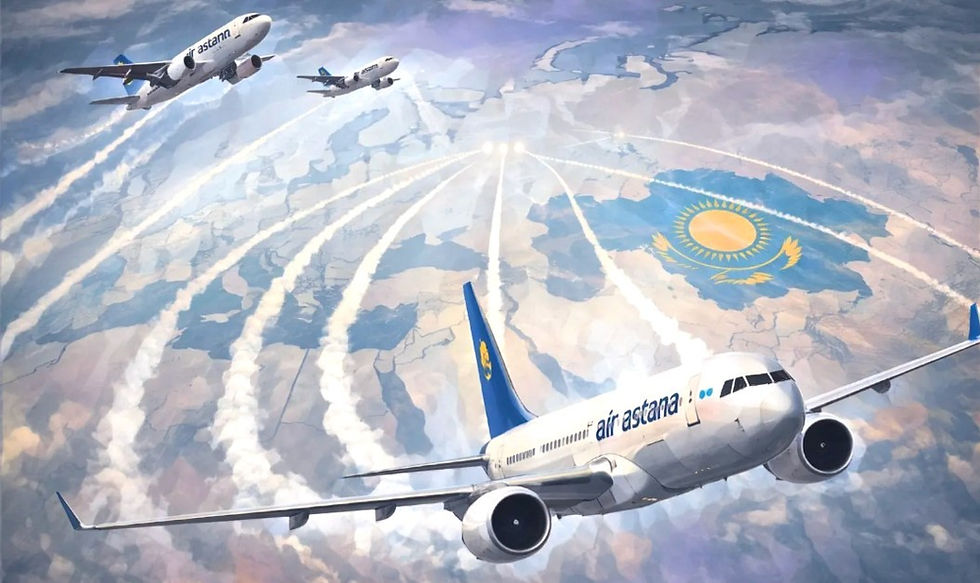
Central Asian authorities are finding their airspace in greater demand as carriers between Europe and Asia avoid parts of the Middle East, but the region is acting more as an alternative corridor than a full replacement for Persian Gulf routes.
European safety regulators have continued to advise airlines to steer clear of large swaths of Iranian and nearby airspace, with their conflict-zone notice set to remain active through March 31. That guidance, together with warnings covering the broader Gulf area, has left carriers with fewer safe direct options. Operators and flight-planning services report that the usual central corridor is effectively off-limits for many, pushing traffic toward a southern sidestep near Oman or a northern arc that threads through the Caucasus and across Central Asian skies.
This shift builds on earlier disruptions. After Russia closed its airspace to many Western carriers following its 2022 invasion of Ukraine, airlines already had to redraw Europe–Asia tracks. In early 2025, one Central Asian carrier began routing Europe flights to avoid both Russian and Belarusian airspace; that adjustment lengthened a Tashkent–Munich trip by several dozen minutes and a few hundred kilometers. Now the same traffic is being nudged from the south, creating a squeeze on the handful of safe passages that remain and prompting a fresh question for local planners: can national systems absorb a higher volume of international overflights without service degradations?
Kazakhstan stands out as the most capable neighbor to take on a larger slice of transit traffic. The state air-navigation agency reports it handled 216,616 flights in the first six months of 2025; roughly three of every four of those flights were foreign carriers, with the rest flown by Kazakh airlines. The country also lists 124 managed air routes whose combined span eclipses 113,500 kilometers. Airport authorities say the country’s terminals served about 31.8 million passengers last year, up from about 29.7 million the year before, while carriers transported some 20.7 million passengers. Kazakhstan’s compliance with international safety benchmarks is cited at roughly 19 out of 20. Officials point to a multi-year development blueprint, a new accident inquiry body and investments in digital control systems and urban air mobility rules.
That capacity, though, isn’t limitless. Central Asia is made up of distinct national aviation systems rather than a single integrated market. Infrastructure quality, investment timelines and regulatory readiness vary from one capital to the next. More overflights mean extra work for air-traffic controllers, greater demand for diversion plans, and bigger stress on airports when disruptions cascade across regions. Meanwhile, the Caucasus and Turkey continue to carry a sizeable portion of rerouted traffic; many flights pass through Azerbaijan or skirt Turkish airspace before moving eastward. Any appraisal of Central Asia’s role must account for that chain of alternatives.
There’s also still a southern fallback. EASA’s latest notices leave some parts of southern routes usable at particular flight levels, so Central Asia is becoming more important without becoming the sole conduit between Europe and Asia. Local aviation analysts say the rise in transit flights can strengthen arguments for upgrading radars, expanding apron capacity and bolstering meteorological services — but they urge measured expectations. “This is an opening for revenue and attention, not a fast track to global hub status,” said a senior adviser at a Kazakh civil aviation think tank. An international aviation consultant added that the value lies in reliability: infrastructure only becomes strategically meaningful if it keeps operating under stress.
For policymakers in Astana, Tashkent and neighboring capitals, the immediate task is practical: shore up controller staffing, improve diversion options and coordinate cross-border procedures so a fragmented system can behave more like a linked one when airlines have few other choices. If they manage that, Central Asian airspace will matter more than before — quietly, incrementally and in ways that will shape routes for months to come.



Комментарии