Kazakhstan’s Population Rise Masks Growing Strain On Jobs And Public Finances

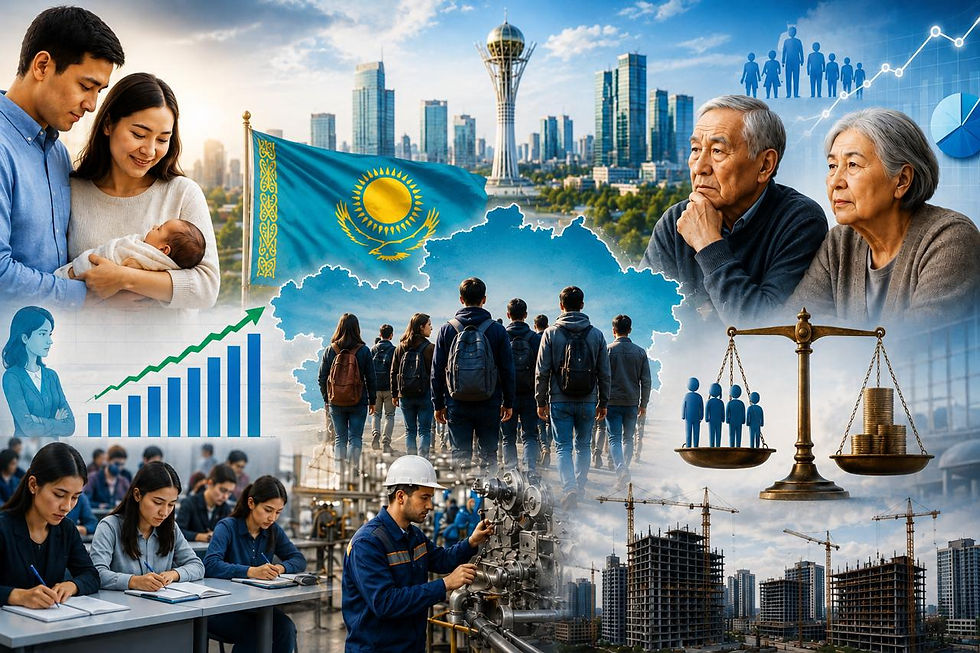
Kazakhstan’s headcount topped about 20.5 million in spring 2026, yet officials and analysts say the apparent growth hides mounting pressures on the labor market and social spending. Births have fallen sharply since their recent high, the population is aging, and a mismatch between graduates’ skills and employers’ needs is beginning to blunt industrial and technological expansion.
Births hit a high of roughly 446,500 in 2021 before sliding to about 335,000 in 2025, according to the national statistics bureau. The average number of children per woman fell to 2.57 last year, the lowest level recorded since 2009. Those numbers come even as the cohort of women of childbearing age expanded to an estimated 4.79 million, a contrast that statisticians say reflects shifting family choices: overall the country registered about 16.43 births for every 1,000 residents, the weakest rate in more than 20 years.
Economic pressures in major urban centers are a major factor in those decisions. Families in Almaty and the capital have increasingly pushed childbearing later because housing is costly and household debt, including mortgages, has risen. The median age for first-time mothers has climbed to nearly 30 years, and persistent double-digit inflation in early 2026 has made larger families less affordable for many in the middle class.
Demographic trends vary sharply by region. Southern and western provinces still record fertility above the replacement threshold of 2.1 children per woman, while parts of the north have fallen to between about 1.63 and 1.75, levels common in parts of Eastern Europe. At the same time, longer lives and relatively low mortality — near 6.64 deaths per 1,000 people over recent years — have contributed to population growth that experts caution may be temporary once the large millennial cohort ages.
The share of working-age people has contracted, raising concerns about funding pensions and health programs. A decade ago, roughly 16/25 of the population was of working age; that share has dropped to about 29/50, increasing the burden on active workers to support retirees. Economists warn that fewer contributors will strain the Unified Accumulative Pension Fund and the Social Health Insurance Fund, while an older population will push up state healthcare costs. Employers in industrial and farming provinces, including North Kazakhstan, are already reporting gaps in crucial occupations.
At the same time the labor force is shifting. The country absorbs more than 350,000 new workers yearly from the generation born in the early 2000s, but many land in retail, delivery, taxi services and other urban platforms rather than technical trades or factory floors. A growing share of young employees work in jobs that demand limited specialized training and often offer irregular social contributions. Academics point to higher education’s tilt toward humanities courses over the past decade as a bottleneck. In response, the education ministry has begun redirecting state grants to technical specialties such as energy, construction and water management, and is tying more state-funded places to university rankings and higher admission thresholds. Officials and analysts agree, however, that the impact of those measures is unlikely to be felt until the end of the decade, when students trained under the new rules enter the job market.



Комментарии