China Backs Kazakhstan’s Grand Urban Plan as Region Deepens Economic Ties
- Andrej Botka
- Jun 18
- 3 min read

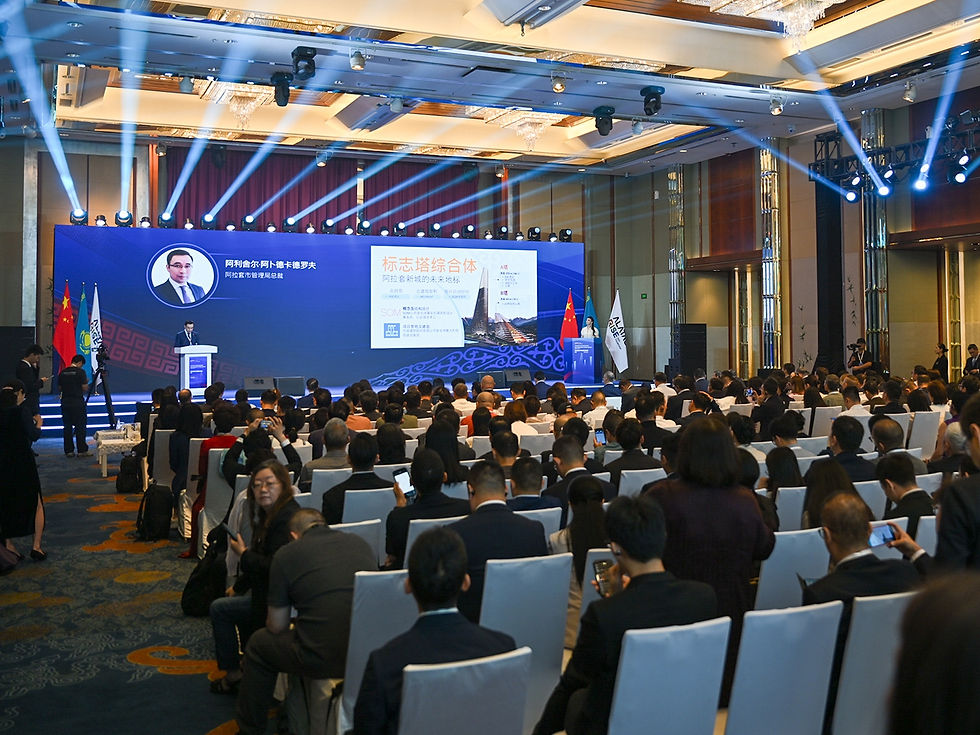
Chinese officials and Kazakh leaders reached preliminary understandings last week on two dozen projects to build Alatau City, an ambitious new urban center north of Almaty that President Kassym-Jomart Tokayev has promoted as a high-tech business and finance hub. The agreements, unveiled at a promotional event in Shenzhen, cover everything from next-generation battery manufacturing and large-scale energy storage to electric-vehicle infrastructure, industrial campus construction and smart-city systems. While none of the deals is finalized, Kazakh and Chinese negotiators placed a combined potential value at roughly six billion dollars — a figure that, if realized, would transform the local economy but leave questions about financing and delivery timetables.
The Alatau plan is being sold to citizens as a chance to create jobs, draw international finance and modernize urban services. City planners emphasize sustainability and digital platforms in their briefings, though observers note the proposal closely echoes development models seen elsewhere. Analysts say the Shenzhen roadshow was as much about attracting private partners as it was about signaling broader economic alignment with Beijing; for now, officials characterize the accords as framework commitments that require follow-up approvals and investment guarantees before construction starts.
Outside the Alatau effort, cooperation with China is expanding across Central Asia in both high-tech and agricultural fields. In southern Kazakhstan, researchers reported successful field trials of a bio-based product designed to protect wheat and orchard crops from Moroccan locust damage, a project carried out with a Chinese agricultural academy. Officials framed the tests as an early win for joint scientific work aimed at securing harvests and reducing environmental degradation.
Beijing is also advancing infrastructure and administrative ties with neighboring Kyrgyzstan. Bishkek and Chinese counterparts have opened talks to revise border procedures and upgrade the Torugart and Irkeshtam crossings to speed freight flows and tighten controls on smuggling and irregular migration. Meanwhile, Kyrgyz regulators say unannounced inspections of construction sites tied to the China-Kyrgyzstan-Uzbekistan rail corridor turned up about 30 breaches of environmental rules, prompting fines. In the financial sector, a bank backed by Chinese investors has emerged as the most heavily capitalized among recent entrants, reporting capitalization of more than 2 billion Kyrgyz soms — roughly $28 million.
In Dushanbe, education officials and a Guangzhou-based consulting firm signed a memorandum to widen cooperation on vocational training, artificial intelligence and expanded Chinese-language instruction, a move that officials say aims to link workforce skills more closely to new industrial projects. And in Turkmenistan, state media report delegations studying Chinese approaches to television and film production, while botanists from Ashgabat and Xinjiang completed fieldwork in protected desert zones to inform a revised national Red Book and a new atlas of desert flora.
Uzbek officials continued talks with Chinese customs brokers on information sharing and joint workshops intended to smooth cross-border trade, and CRRC-refurbished locomotives have returned to service in the Tashkent region. Two dual-use electric engines rejoined operations after overhaul in China, with plans to modernize about a dozen units and stage deliveries of roughly 38 additional freight, passenger and shunting locomotives through the early 2030s. A recent Shanghai forum brought Uzbek and Chinese think tanks together to discuss next steps in bilateral cooperation, underscoring that ties now span hard infrastructure, human capital and policy dialogue.
Taken together, the week’s developments show China broadening a mix of commercial, technical and cultural links across Central Asia. Observers caution that the speed and depth of implementation will hinge on financing details, environmental safeguards and local governance capacity — factors that will determine whether these headlines translate into lasting economic change for communities on the ground.


Comments