Erdogan’s Visit Puts Trans-Caspian Transit at Center of Turkey-Kazakhstan Agenda
- Andrej Botka
- May 21
- 2 min read

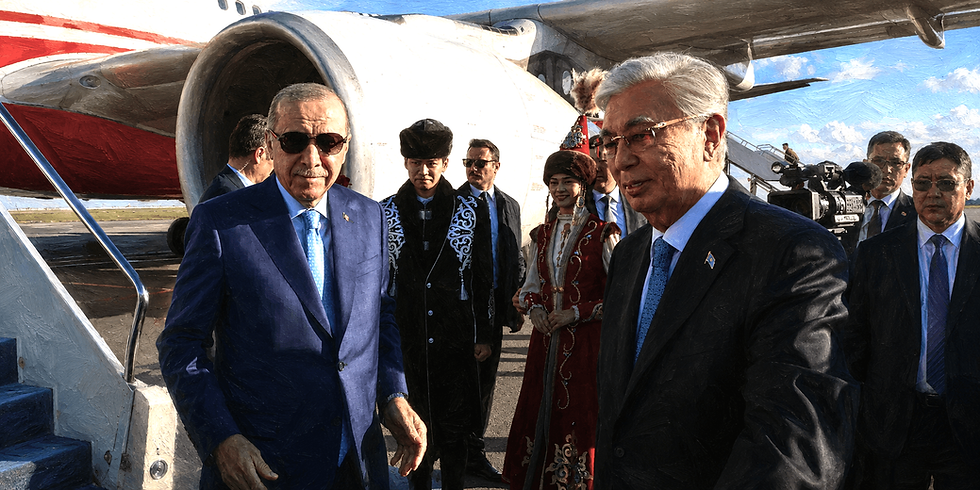
Turkish President Recep Tayyip Erdogan used a state visit to Kazakhstan to press plans for expanding the Trans-Caspian International Transport Route — often called the Middle Corridor — setting trade and transit projects at the top of talks with Kazakh President Kassym-Jomart Tokayev. Officials signed a slate of agreements aimed at boosting rail, port and airport links even as Astana made clear it will keep a broadly diversified foreign policy.
Erdogan and Tokayev framed the corridor as a key east-west artery across the Caspian Sea that can shorten delivery times and open markets. Erdogan described the route as a strategic maritime and overland connection linking Europe and Asia, and both sides agreed to pursue measures to raise its throughput and reliability in the coming years.
Kazakh officials emphasized the visit’s cultural and economic dimensions as much as the transit agenda. The joint declarations covered expanded cultural exchanges, humanitarian cooperation and stepped-up investment pledges, including further work on Almaty’s international airport, which is operated by Turkey’s TAV. Officials also highlighted projects at the Aktau and Kuryk ports and increased use of pipelines that channel crude from the Caspian toward Mediterranean export points.
Analysts say the visit illustrates mutual gains: Ankara secures a stronger foothold into Central Asia, while Astana builds alternative routes to global markets. One analyst noted that combined efforts on the Trans-Caspian route have already cut transit time for some shipments to roughly 13 days. Another pointed out that rail freight between the two countries rose by about one-third last year, while trucked cargo grew by roughly one-twentieth.
Economic figures underline an asymmetry in the relationship. Turkish capital in Kazakhstan totals about $6 billion, compared with roughly $2.5 billion of Kazakh investment in Turkey — more than double. There are nearly 3,800 Turkish firms operating in Kazakhstan, bilateral trade runs near $5 billion, and about 14,000 Kazakh students study in Turkish institutions, observers noted.
Observers say the tone in Astana was cordial and ceremonial, but not subordinating. Kazakh diplomats repeatedly stressed their country’s independent positions across international issues even as they deepen cooperation with Turkey. The visit, they add, offers a clear example of how Kazakhstan’s multi-directional diplomacy functions: close partnerships that increase economic opportunity while preserving strategic flexibility.


Comments