Kazakhstan, European Firms Sign $462 Million Deal Package to Bolster Trans-Caspian Transport
- Andrej Botka
- Jun 25
- 2 min read

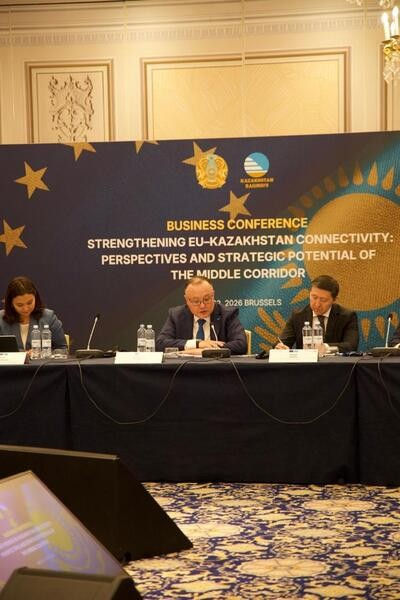
Brussels — Kazakhstan and a cohort of European partners on June 22 formalized four transport agreements valued at a combined $462 million, aiming to speed up and expand the Trans-Caspian International Transport Route — the so-called Middle Corridor — as President Kassym-Jomart Tokayev visited Belgium. The accords were unveiled at a high-level conference on EU-Kazakhstan connectivity attended by officials from the European Commission and Parliament, international financiers and major logistics and rail companies, underscoring a push to diversify Eurasian trade links away from routes that traverse Russia.
The set of documents covers several sectors of the corridor. Kazakhstan’s transport ministry and SITA agreed to collaborate on upgraded digital systems for state airports, including biometric passenger processing. The European Bank for Reconstruction and Development agreed to lend funds to QazAvtoZhol for the Aktobe–Ulgaisyn stretch — about 234 kilometers on the Western Europe–Western China corridor — to smooth regional and transit traffic. KTZ Express, the rail operator’s logistics arm, struck a deal with Romania’s Midia Marine Terminal to enhance Black Sea handling capacity, and separately reached an arrangement with A.P. Moller‑Maersk to step up container services along the Trans‑Caspian route.
Conference organizers placed heavy emphasis on capacity-building: widening rail and terminal throughput, upgrading ports, streamlining cross‑border procedures through digital tools and building greener supply chains across Eurasia. Representatives framed the Middle Corridor not merely as an alternative passage but as a strategic transport axis whose efficiency hinges on modern terminals, synchronized paperwork and private‑sector cargo commitments. Several participants noted the corridor dovetails with the EU’s Global Gateway priorities, which have already earmarked support for infrastructure and procedural modernization in the region.
Officials pointed to rapid traffic growth: freight moving on the Trans‑Caspian link has climbed to more than three times previous volumes in recent years, and investments in infrastructure and logistics have shortened transit times between China and Europe. The EU remains Kazakhstan’s top economic partner, with two‑way trade last year reaching roughly $45 billion and cumulative investment from EU states topping the two‑hundred‑billion‑dollar mark, according to Kazakh officials.
Analysts cautioned that while the agreements are a concrete step, they represent early-stage moves in a long build‑out. A London‑based transport consultant said the package could unlock further modal shifts only if ports on the Caspian and the Black Sea scale up fast and customs procedures are harmonized; otherwise bottlenecks will simply move from one point to another. Environmental and funding questions will also determine how quickly rail and road sections can be modernized without creating new fiscal strains.
The timing — announced during Tokayev’s Belgian visit and following a June workshop in Astana on corridor coordination — is intended to accelerate implementation this year. Backers say the next phase will focus on project timelines, attracting steady cargo volumes and aligning digital systems so goods can move more predictably between East and West.


Comments