Kazakhstan Rail Operator Builds Caspian Shipping Line, Moves Toward Own Air Cargo Service
- Andrej Botka
- May 21
- 3 min read

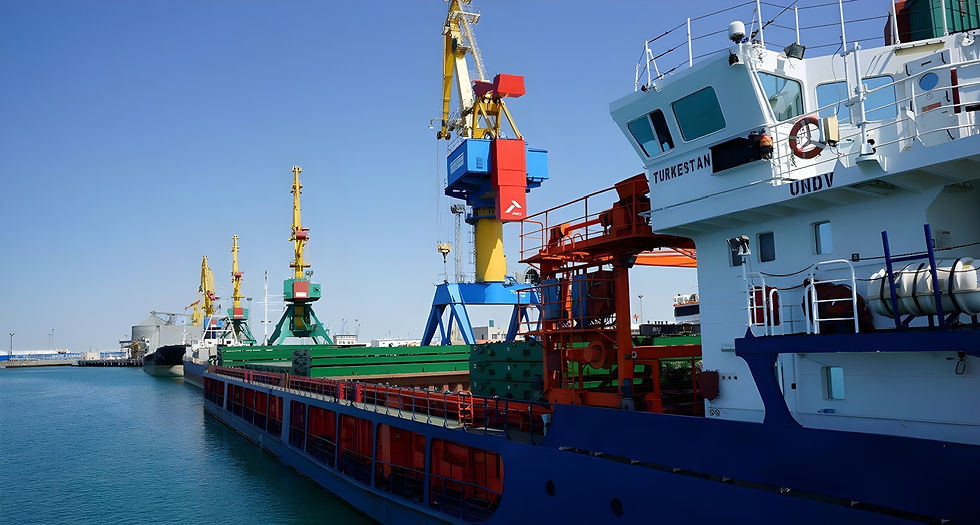
Kazakhstan’s state rail operator is adding sea and air links to its transit toolkit as it seeks a bigger share of Europe-Asia freight moving along the Middle Corridor.
Kazakhstan Temir Zholy has contracted for the construction of six new roll-on/roll-off and container-capable vessels to serve routes across the Caspian and, potentially, the Black Sea. Four ships will be assembled by a yard in Jiangsu, China, and two by Baku Shipyard in Azerbaijan, the company said in a notice. Each ship is sized to carry about 537 standard 20-foot containers, and KTZ officials say the new capacity will let the carrier stitch maritime segments into rail schedules more tightly.
Industry watchers say the move could reduce delays that have long dogged trans-Caspian links. “Owning the boats gives the operator more control over timetables and equipment handoffs,” said an Almaty-based logistics analyst. He added, however, that the venture will require clear timetables and spare parts plans to avoid creating new bottlenecks. KTZ has not published a firm start date for sailings; construction and delivery schedules for the Chinese and Azerbaijani yards will determine when the service can open.
On the aviation front, KTZ Express filed documents last autumn to register a cargo airline under the railway group, with plans to operate a fleet of 10 freighter jets. Officials had hoped the first flight would be airborne in early 2026, but the airline is not yet flying. President Kassym-Jomart Tokayev has urged the country to position itself as a major air-cargo node between Europe and Asia, and state planners have repeatedly cited air links as a way to speed high-value shipments along overland corridors.
Other transport and trade developments in Kazakhstan this spring underline the government’s push to upgrade logistics and processing. Astana hosted a signing for a deep-processing grain facility in the Akmola region, a project valued at 300 billion tenge, about $640 million. Agricultural exporters also reported a surge in feed-meal shipments to China: nearly 2.2 million tons left Kazakhstan during the September–March marketing window, more than twice the volume from the prior comparable period. Lawmakers recently ratified an updated investment-protection agreement with China that replaces a 1992 pact, reflecting the sharp rise in cross-border capital flows.
Private-sector partnerships are growing too. A Kazakh startup signed a white-label deal with a Chinese smart-access manufacturer to help that firm enter the German market. Under the arrangement, the Chinese partner will supply hardware and logistics, while the Kazakh firm provides software that handles data protection and local payment integration, meeting European regulatory demands, according to industry filings.
Across Central Asia, diplomatic and commercial engagement with China continued this spring. Kyrgyz officials sent a high-level delegation to China that included the energy minister and a presidential special envoy; the most tangible outcome reported so far is an agreement to host a visiting trade mission from Zhejiang province. Uzbekistan’s prime minister led a delegation to Hong Kong that produced about 15 memorandums, covering agricultural investments worth more than $550 million and a 150-megawatt energy-storage project in the Samarkand area. Uzbekistan Airways will open a regular route to Guangzhou on May 27. In Ashgabat, Turkmen officials met with representatives of Chinese telecoms, including Huawei and ZTE, to discuss AI research centers and pilot “smart city” work, while agricultural authorities are testing seven Chinese cotton-seed varieties on roughly 650 hectares amid ongoing concerns from watchdogs about labor practices in the sector.


Comments