Kyrgyz Leader Seeks Capital in Tashkent, Pitching Regional Partnership and Rapid Reform
- Andrej Botka
- Jun 18
- 3 min read

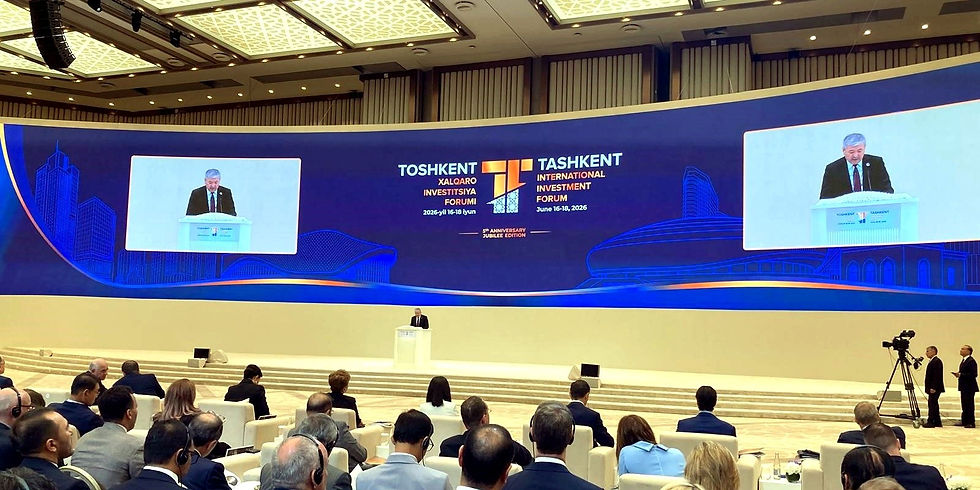
Kyrgyz Prime Minister Adylbek Kasymaliev used a high-profile investment forum in Tashkent on Wednesday to press investors for projects tied to a regional economic push, saying his government is ready to welcome deals that aren’t conditioned on political strings. Speaking at the opening of the fifth Tashkent International Investment Forum, he framed Kyrgyzstan’s appeal around a domestic development plan that targets accelerated industrial growth, a shift toward exports and digital reforms intended to lift the country into upper-middle-income status by 2030. He pointed to recent figures showing growth roughly equal to one in nine as signs the strategy is producing early results.
The forum in Uzbekistan has become, in Kasymaliev’s telling, more than a meeting place for officials; it’s where neighboring capitals are negotiating shared economic projects that could reshape trade across Central Asia. For local manufacturers, farmers and service providers in Kyrgyzstan, that translates into promises of better logistics, new processing plants and more buyers abroad — if the government can move quickly and make its rules predictable. Kasymaliev urged faster decision-making and clearer regulations as the best way for countries in the region to turn global disruptions into opportunities.
He outlined six priority areas where Kyrgyzstan wants outside capital and joint ventures. First, the government wants to go beyond simply digging up ores and minerals; it seeks investment in domestic processing and component fabrication for green-energy supply chains. Second, energy plans center on renewables — small hydropower, solar, wind and future hydrogen projects — with a five-year profit-tax holiday for qualifying producers. Third, agribusiness development is focused on processing, controlled-environment greenhouses and cold-chain storage to serve markets in neighboring states, the Middle East, South Asia and China. Fourth, transport ambitions hinge on the China-Kyrgyzstan-Uzbekistan rail link, which officials say will tighten freight times to about ten days. Fifth, a newly enacted Digital Code aims to pull more venture money into startups and build a local tech market. And sixth, plans to privatize some state enterprises and to create the Tamchy Special Financial Investment Territory on Lake Issyk-Kul are pitched as ways to draw international capital under bespoke rules.
Outside analysts welcomed the ambitions but warned that execution will be the test. "The goals are sensible, but turning mined ore into exported goods, or moving from policy announcements to actual factories, requires sustained investment in skills, governance and environmental safeguards," said Almaz Dzhumagulov, an economic analyst based in Bishkek. He added that hydropower and mining expansions carry social and ecological trade-offs that need clearer mitigation plans. Other advisers suggested Kyrgyzstan focus first on a few pilot projects to build investor confidence before scaling up.
Kasymaliev tied much of the urgency to broader global shifts — technological advances, changing energy sources and reconfigured supply chains — arguing that governments that set transparent rules and act promptly will capture the lion’s share of emerging business. That pitch was aimed as much at regional partners as it was at international financiers: stronger ties with neighbors, he said, make Kyrgyz projects more viable, not less.
He closed by stressing a regional rather than a purely national approach, saying recent increases in political dialogue and cross-border cooperation have made Central Asia more attractive to investors. Several private-sector delegates expressed guarded interest, praising the policy direction while noting they want concrete tenders and legal certainty before committing major capital.


Comments