Uzbekistan’s Venice Pavilion Turns the Aral Sea Into a Pulsing, Poetic Installation
- Andrej Botka
- Jun 11
- 2 min read

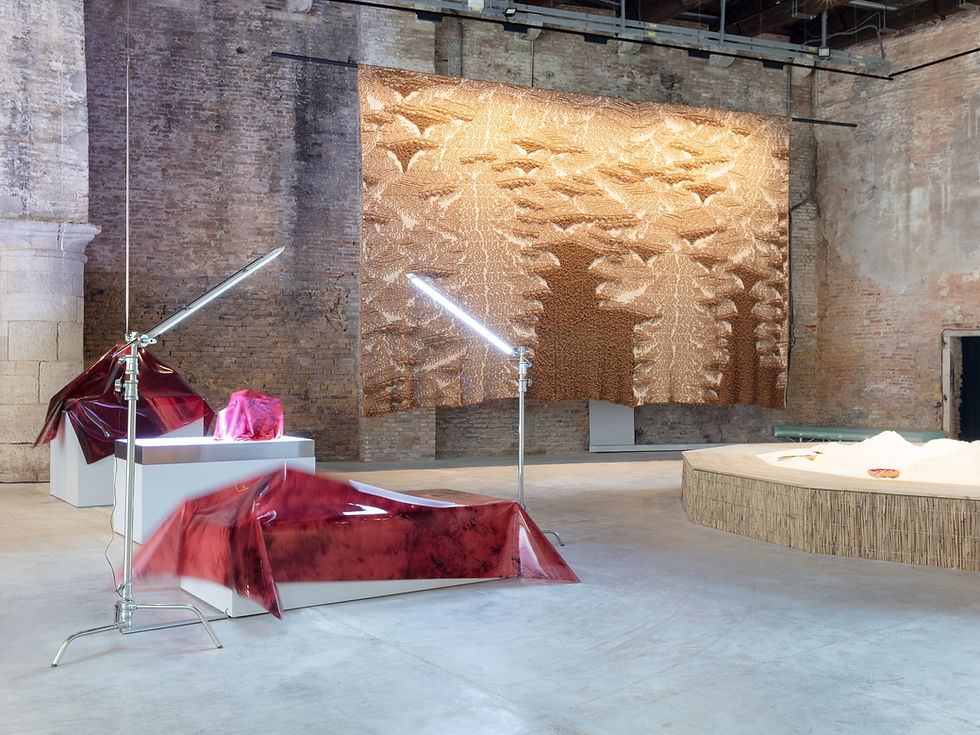
The Uzbekistan National Pavilion at the 61st Venice Biennale is presenting a sensory installation that reimagines the Aral Sea as a site of ongoing change and memory. The show, titled The Aural Sea, fills Quarta Tesa in the Arsenale with moving mechanisms and large-scale translucent prints, and runs through Nov. 22, 2026 as part of the international exhibition.
Inside the space, visitors encounter motor-driven structures that swell and subside on repeated cycles, their movement setting a slow, audible tempo through the room. Large, color-treated photographs of the Aral landscape are printed on semi-opaque PVC panels; when light passes through them the scenes acquire depth and a soft glow, turning photographic detail into layered, luminous planes rather than straightforward documentation.
The pavilion pairs a restrained, evocative aesthetic with clear references to environmental collapse. A curator involved in mounting the presentation described the work as aiming to register loss without resorting to spectacle, trusting subtle material choices to carry emotional weight. Local artists and researchers contributed source images and oral histories, anchoring the installations in voices from communities affected by the sea’s retreat.
The Aral’s decline began in the mid-20th century as river diversion for irrigation left shores exposed and fishing towns stranded; today the basin is frequently cited in discussions about large-scale ecological disruption. By treating the vanished waters as a changing, almost living presence, the pavilion asks visitors to consider how memory, science and art can combine to shape public attention.
While the show avoids didactic displays, it raises questions about the limits of aesthetic response to human and environmental harm. Still, for audiences in Venice the work offers a different path: an invitation to listen, to look through material layers, and to reckon with a region whose recent history continues to unfold.


Comments